I’d just finished getting my hair cut and styled at the one salon in
London that specializes in curls only to walk out the door to find it
was pouring rain. The nearest Tube station was shut that Saturday for
engineering works, so I scurried down the side streets of the West
London neighborhood to the closest alternative, about a 20-minute walk
away.
Determined to protect my neatly defined coils from unravelling into a
mass of frizz, I huddled under the red umbrella with a duck-head handle
I carry with me every day. Google Maps recommended I walk through
Portobello Market, where merchants selling vintage clothing, handbags
and antiques seemed as unperturbed by the rain and near-zero January
temperatures as the hundreds of would-be shoppers crowding the length of
the road.
With no interest in shopping, my entire focus was to protect my hair
from the rain. I tried carefully to navigate my way through the sea of
umbrellas without poking anyone in the eye with the exposed metal spike
that never failed to come undone from the nylon canopy at inconvenient
moments like that one.
Before entering the final stretch of the street market, I came to an
intersection. The pedestrian signal had just turned red, so I waited at
the corner of the sidewalk, oblivious to the large puddle of water that
had accumulated at the curb beneath my feet. Before I had a moment to
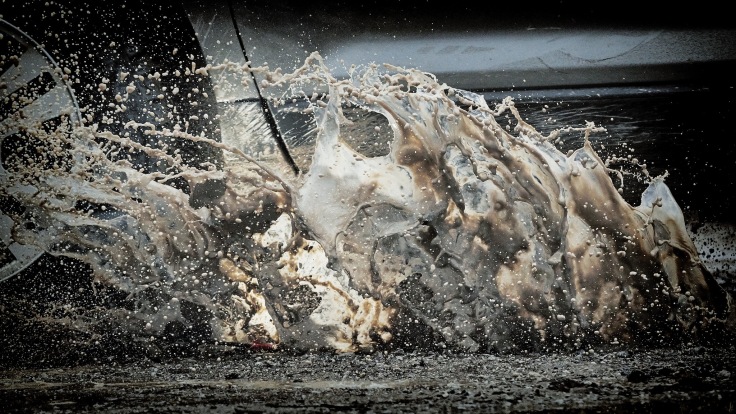
look down or back away, a car sped through the pool of rainwater, which
splashed up and left me totally drenched from the waist down.
I paused for a moment from the shock.
But I didn’t get angry.
I didn’t feel moved to curse out loud at the driver or complain bitterly to whoever was close enough to hear.
Nor did I feel embarrassed at being the only pedestrian at the
intersection who seemed to lack the foresight to leave a little distance
from the curb.
I felt — grateful.
“Alhamdulillah,” I mumbled to myself as I looked down at my skirt and tights that were soaked through to the skin. “Ashukrlillah.” “Splash” by WS Squared Photography
The reaction surprised me. Not that long ago, a similar sequence of
events would have sent me spinning into feelings of self pity,
self-consciousness and whining at how unfair the universe was.
But something is shifting in me now. I
hear Dede’s voice in my head urging us, as an important first step to
spiritual transformation, to stop complaining and seeing the problems in
everything. Each moment contains a reason
to be grateful, he says. Gratitude to be alive, conscious, breathing.
Even when we’re irritated and dissatisfied, we can be thankful for
whatever the Divine Reality, Allah, has in store for us each day.
Huddled at the back, left-hand corner of a large hall, me and a handful of other women would gather to take part in the Islamic Friday prayer at our university in British Columbia the early 2000s. Meanwhile at the front of the room, where light streamed in from the windows, dozens of young men stood side-by-side in rows.
We recited the same prayer, but the gap in our experience was far wider than the swath of carpet separating the masculine and feminine in most Islamic religious spaces. As soon as we would say our final salams, I would dash for the door as quickly as I’d arrived.
Attending congregational prayers — where women are typically relegated to back corner, behind a partition or in a windowless room of a mosque — has always been an awkward and disheartening experience for me. The rigid segregation of religious spaces made me hyper aware of the limitations of my feminine identity, which I realized only years later were imposed on me rather than intrinsic to the tradition. That gnawing sense of discomfort made me ashamed of my girlhood, and eventually my womanhood in ways I can only now begin to articulate.
I was so immersed in patriarchy during my childhood that I assumed messages of faith could be communicated only through the masculine voice. After all, most references I encountered of God were as “He” and all the prophets in Abrahamic traditions were men.
Yet as I got older, my most intimate moments with Allah in personal sacred spaces had an entirely different quality. During early-morning prostrations before my Beloved, I had a deep sense that our connection was beyond constructions of gender and beyond my supposed inferiority. Rather, it was an exchange of energies that was deeply loving and nourishing. Something wasn’t right with the prevailing, masculine narrative of Islam, but I was unable to put my finger on why.
Image by Irina Naji
That changed when I became acquainted with the powerful women who have been largely erased from our spiritual histories. Their voices are muffled and faint not because they didn’t exist, but because they’ve been hidden and written out of relevance by patriarchal readings and writings of Islam.
The 2010 Hollywood celebrity fest chick-flick Valentine’s Day opens with Reed Bennett, a florist played by Ashton Kutscher, proposing marriage to Morley (Jessica Alba), as she wakes up on Feb. 14.
Evidently startled, Morley initially accepts, sending Reed on a joyful mission to let everyone know his sweetheart said “yes”! But his elation is short-lived. A few hours later Reed finds Morley in his apartment packing her bag as she hands back his ring and walks out on the relationship entirely.
Just then, as movie’s downtrodden protagonist leaves the scene, the narrator — a radio show host named “Romeo Midnight” — drops a word of wisdom that sounds a tinge sufi.
“It’s Romeo Midnight back again. And if those topsy-turvy feelings have got you twisted inside out, think of the poet Rumi who 800 years ago said: `All we really want is love’s confusing joy.’ Amen, brother.”
Heart of Steel, by Livlu Ghemaru
When I watched this movie shortly after its release, I was bemused at the irony of hearing a 13th-century Islamic poet and scholar quoted in a cheesy American blockbuster seemingly unwittingly. A Persian poet of love, Rumi is often uprooted from his historical context and polished for resale for Western audiences who may not realize his object of affection isn’t a romantic love interest, but the Divine Beloved.
In the heap of objects strewn across the dining room floor, I spotted
a sterling silver sugar bowl that was part of a four-piece tea set my
mom bought about three decades ago to entertain guests. I picked up the
bowl with one hand, while using the other to rummage through the pile of
papers, cloth napkins, tupperware and cutlery scattered beneath my
feet. I was curious whether the rest of the silverware was somewhere in
the mess left by the burglars.
When I couldn’t find it there, I
turned my head toward the tall oak buffet beside me, whose contents had
mostly been dispersed onto the carpet. Nestled in the corner of one
cabinet, the tea pot, tray and cream pitcher lay untouched.
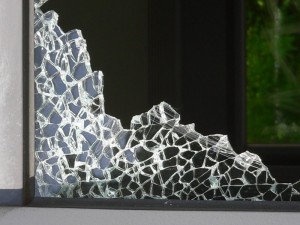
Shattered window, by Georg Slickers
The
sight of them startled me. A thick layer of black film had formed on
the surface of the silver, making it unrecognizable against the
shimmering exterior in my memory. It was no wonder the burglars who
ransacked our family home in Canada several weeks earlier had
disregarded the ensemble as they hauled away several electronics,
appliances and gadgets.
At that moment, a saying of the Prophet
Muhammad, peace and blessings be upon him, crossed my mind. “There’s a
polish for everything that takes away rust,” he said. “And the polish
for the heart is the remembrance of God.”
That was perhaps the
first time I’d considered this Hadith in a literal way. Acting on an
impulse, I grabbed an old bottle of silver polish from the mess on the
dining room floor and a soft sponge from under the kitchen sink, and
started to vigorously rub the tea pot. I was determined to make it shine
again like it did during my pre-teen years in Lethbridge and Calgary,
when my mom would fill it with her favored Red Rose tea to serve to
visitors alongside a slice of vanilla cake or syrup-drenched Egyptian basboosa.
Part
of me was grateful for a distraction from the pangs of sadness I felt
at seeing almost every corner of our four-bedroom family home turned
upside down. After learning of the break in, my sister and I made the
10-hour plane journey from London to Vancouver to assess the damage. We
found the contents and memorabilia contained in closets, cupboards and
drawers sprawled over our maroon-colored carpets.
Yet I wasn’t
mourning stolen possessions. The home I’d lived in as a student, and
visited almost every year since moving away after university, just felt
different. During those first few nights, each creak of the walls and
squeak of the furnace would cause a stir inside me. I envisioned we were
on the verge of another invasion of our privacy.
So as I hunched
over the counter top removing years of residue from the silverware, part
of me was nursing feelings of guilt for failing to safeguard our family
sanctuary. We’d made it easy for the robbers, who shattered the window
next to the front door and let themselves in when no one was in town.
There
was another motivation, though, for my spontaneous urge to shine the
silver. I was seeking reassurance that the polish would work when up
against years of neglect visible on the surface.
Turning on a tune by Egyptian legend Abdel Halim Hafez, my sister Mandy handed her iPod to Uncle Hoda and gestured him to place the headphones over his ears. Seconds later, an expression combining astonishment and glee came over his face while listening to a melody that must have taken him back at least three decades. Our uncle laughed and sang along to the words of “Gana El Hawa, the Love Came to Us,” while swaying his head from side to side, fully mesmerized in enjoyment of the moment.
If there’s anything that I will always treasure about my Uncle Hoda, who passed away last month following a battle with cancer, God bless his soul, it is that he was among only a small number of people that I’ve encountered who lived for the present.
I imagine it was Uncle Hoda’s deep connection with God that enabled him to embody this state of being. He spoke with great reverence of the Divine, and the love that sprang from that bond was contagious. Positivity and optimism radiated from him; whenever he entered a room, it was with the lightness and calmness of a person who was content with the joys and patient with the challenges of his life.
As my two sisters and I reminisced in our Whatsapp chat room about our beloved maternal uncle in the days following his passing, we alternated between tears and laughter. I was struck at how profoundly he had affected each of us, given we lived far apart most of our lives, Uncle Hoda in Egypt and us in a scattering of cities around North America, the Arabian Gulf and Europe.
It was joyous to reunite with our uncle during summer holidays, the distresses of our childhood dissolving away in his playful presence. He was consistently ready to offer a smile, which would make his small eyes almost disappear beneath his bushy eyebrows. Whether he was getting us to hum and sing along to the latest Egyptian pop song or sending us into an endless round of giggles during an afternoon drive around Cairo by swerving his car to the right and left in a zigzag pattern, Uncle Hoda always made us feel like the centre of his attention.