Showing posts with label Discovering Islam. Show all posts

Sunday, 25 March 2018

My Journey From ‘Moderate’ Muslim to Seeker of Love


For many years starting at around the time of the 9-11 terror attacks, I referred to myself a “moderate Muslim.” I used the term on my Facebook profile and pronounced it if asked about my religious beliefs.

The label was in many ways a reactive disclaimer to popular opinion about Muslims. It meant for me that I was raised in an Arab, Islamic household in the West, I rejected extremism and was tolerant of diversity and multiculturalism. I was an approachable and modern professional who didn’t take religion too seriously. I still felt a deep connection to my inherited identity, albeit with limited critical reflection. I believed in God, fasted during Ramadan and prayed on occasion, but rarely with a deep amount of presence or the Divine at the center of my consciousness.

I suppose the label also insinuated that I wasn’t fully Muslim in the way people perceived Muslims. Becoming “fundamentalist” in following the tenets of the mainstream religion was seen as synonymous with being radicalized. So I didn’t bother.

Several years passed and life, as it does, handed me one setback to negotiate after another. Each of them, slowly but surely, pulled me further and further away from God. I was left questioning what the point of faith, and for that matter life, was at all. Then, just as I was abandoning the religion I’d known my whole life, I had my first encounter with spiritual Islam.

It was almost eight years ago, and the tender sensations that coursed through my veins still induce goose bumps. Unable to sleep, I’d been sitting on my living room floor trying to decipher how to cope with my latest misfortune and understand why I deserved it. Then, in a burst of inspiration, my perception shifted. I saw that what I’d perceived just the moment before as a disappointment was actually a blessing, for it led me to be receptive to the guidance that was unfolding within me.

Saturday, 10 February 2018

Thanking Big


I’d just finished getting my hair cut and styled at the one salon in London that specializes in curls only to walk out the door to find it was pouring rain. The nearest Tube station was shut that Saturday for engineering works, so I scurried down the side streets of the West London neighborhood to the closest alternative, about a 20-minute walk away.

Determined to protect my neatly defined coils from unravelling into a mass of frizz, I huddled under the red umbrella with a duck-head handle I carry with me every day.

 Google Maps recommended I walk through Portobello Market, where merchants selling vintage clothing, handbags and antiques seemed as unperturbed by the rain and near-zero January temperatures as the hundreds of would-be shoppers crowding the length of the road.

With no interest in shopping, my entire focus was to protect my hair from the rain. I tried carefully to navigate my way through the sea of umbrellas without poking anyone in the eye with the exposed metal spike that never failed to come undone from the nylon canopy at inconvenient moments like that one.

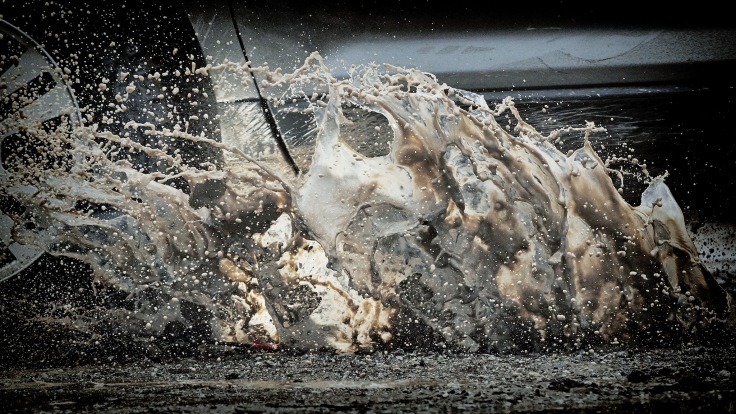
Before entering the final stretch of the street market, I came to an intersection. The pedestrian signal had just turned red, so I waited at the corner of the sidewalk, oblivious to the large puddle of water that had accumulated at the curb beneath my feet. Before I had a moment to look down or back away, a car sped through the pool of rainwater, which splashed up and left me totally drenched from the waist down.

I paused for a moment from the shock.

But I didn’t get angry.

I didn’t feel moved to curse out loud at the driver or complain bitterly to whoever was close enough to hear.

Nor did I feel embarrassed at being the only pedestrian at the intersection who seemed to lack the foresight to leave a little distance from the curb.

I felt — grateful.

“Alhamdulillah,” I mumbled to myself as I looked down at my skirt and tights that were soaked through to the skin. “Ashukrlillah.”
WS Squared Photography
“Splash” by WS Squared Photography
The reaction surprised me. Not that long ago, a similar sequence of events would have sent me spinning into feelings of self pity, self-consciousness and whining at how unfair the universe was.

But something is shifting in me now. I hear Dede’s voice in my head urging us, as an important first step to spiritual transformation, to stop complaining and seeing the problems in everything. Each moment contains a reason to be grateful, he says. Gratitude to be alive, conscious, breathing. Even when we’re irritated and dissatisfied, we can be thankful for whatever the Divine Reality, Allah, has in store for us each day.

Monday, 13 February 2017

Translating Love’s Confusion: Hollywood and Misreading Rumi

The 2010 Hollywood celebrity fest chick-flick Valentine’s Day opens with Reed Bennett, a florist played by Ashton Kutscher, proposing marriage to Morley (Jessica Alba), as she wakes up on Feb. 14.
Evidently startled, Morley initially accepts, sending Reed on a joyful mission to let everyone know his sweetheart said “yes”! But his elation is short-lived. A few hours later Reed finds Morley in his apartment packing her bag as she hands back his ring and walks out on the relationship entirely.
Just then, as movie’s downtrodden protagonist leaves the scene, the narrator — a radio show host named “Romeo Midnight” — drops a word of wisdom that sounds a tinge sufi.
“It’s Romeo Midnight back again. And if those topsy-turvy feelings have got you twisted inside out, think of the poet Rumi who 800 years ago said: `All we really want is love’s confusing joy.’ Amen, brother.”
Heart of Steel, by Livlu Ghemaru
When I watched this movie shortly after its release, I was bemused at the irony of hearing a 13th-century Islamic poet and scholar quoted in a cheesy American blockbuster seemingly unwittingly. A Persian poet of love, Rumi is often uprooted from his historical context and polished for resale for Western audiences who may not realize his object of affection isn’t a romantic love interest, but the Divine Beloved.

Thursday, 19 January 2017

Spiritual Wisdom In A Treasure The Burglars Left Behind

In the heap of objects strewn across the dining room floor, I spotted a sterling silver sugar bowl that was part of a four-piece tea set my mom bought about three decades ago to entertain guests. I picked up the bowl with one hand, while using the other to rummage through the pile of papers, cloth napkins, tupperware and cutlery scattered beneath my feet. I was curious whether the rest of the silverware was somewhere in the mess left by the burglars.

When I couldn’t find it there, I turned my head toward the tall oak buffet beside me, whose contents had mostly been dispersed onto the carpet. Nestled in the corner of one cabinet, the tea pot, tray and cream pitcher lay untouched.
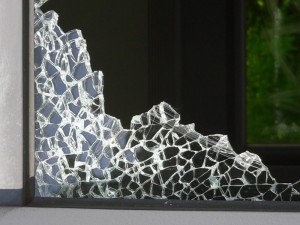
Broken glass
Shattered window, by Georg Slickers
The sight of them startled me. A thick layer of black film had formed on the surface of the silver, making it unrecognizable against the shimmering exterior in my memory. It was no wonder the burglars who ransacked our family home in Canada several weeks earlier had disregarded the ensemble as they hauled away several electronics, appliances and gadgets.

At that moment, a saying of the Prophet Muhammad, peace and blessings be upon him, crossed my mind. “There’s a polish for everything that takes away rust,” he said. “And the polish for the heart is the remembrance of God.”

That was perhaps the first time I’d considered this Hadith in a literal way. Acting on an impulse, I grabbed an old bottle of silver polish from the mess on the dining room floor and a soft sponge from under the kitchen sink, and started to vigorously rub the tea pot. I was determined to make it shine again like it did during my pre-teen years in Lethbridge and Calgary, when my mom would fill it with her favored Red Rose tea to serve to visitors alongside a slice of vanilla cake or syrup-drenched Egyptian basboosa.

Part of me was grateful for a distraction from the pangs of sadness I felt at seeing almost every corner of our four-bedroom family home turned upside down. After learning of the break in, my sister and I made the 10-hour plane journey from London to Vancouver to assess the damage. We found the contents and memorabilia contained in closets, cupboards and drawers sprawled over our maroon-colored carpets.

Yet I wasn’t mourning stolen possessions. The home I’d lived in as a student, and visited almost every year since moving away after university, just felt different. During those first few nights, each creak of the walls and squeak of the furnace would cause a stir inside me. I envisioned we were on the verge of another invasion of our privacy.

So as I hunched over the counter top removing years of residue from the silverware, part of me was nursing feelings of guilt for failing to safeguard our family sanctuary. We’d made it easy for the robbers, who shattered the window next to the front door and let themselves in when no one was in town.

There was another motivation, though, for my spontaneous urge to shine the silver. I was seeking reassurance that the polish would work when up against years of neglect visible on the surface.

Friday, 4 November 2016

Lessons on living from my late uncle

Turning on a tune by Egyptian legend Abdel Halim Hafez, my sister Mandy handed her iPod to Uncle Hoda and gestured him to place the headphones over his ears. Seconds later, an expression combining astonishment and glee came over his face while listening to a melody that must have taken him back at least three decades. Our uncle laughed and sang along to the words of “Gana El Hawa, the Love Came to Us,” while swaying his head from side to side, fully mesmerized in enjoyment of the moment.

If there’s anything that I will always treasure about my Uncle Hoda, who passed away last month following a battle with cancer, God bless his soul, it is that he was among only a small number of people that I’ve encountered who lived for the present.

I imagine it was Uncle Hoda’s deep connection with God that enabled him to embody this state of being. He spoke with great reverence of the Divine, and the love that sprang from that bond was contagious. Positivity and optimism radiated from him; whenever he entered a room, it was with the lightness and calmness of a person who was content with the joys and patient with the challenges of his life.

As my two sisters and I reminisced in our Whatsapp chat room about our beloved maternal uncle in the days following his passing, we alternated between tears and laughter. I was struck at how profoundly he had affected each of us, given we lived far apart most of our lives, Uncle Hoda in Egypt and us in a scattering of cities around North America, the Arabian Gulf and Europe.

It was joyous to reunite with our uncle during summer holidays, the distresses of our childhood dissolving away in his playful presence. He was consistently ready to offer a smile, which would make his small eyes almost disappear beneath his bushy eyebrows. Whether he was getting us to hum and sing along to the latest Egyptian pop song or sending us into an endless round of giggles during an afternoon drive around Cairo by swerving his car to the right and left in a zigzag pattern, Uncle Hoda always made us feel like the centre of his attention.

Friday, 16 September 2016

Forgiving my reflection

Sufi stories and poetry often allude to mirrors. Not the ones that immediately come to mind which we look at each day to see the outer image we project to the world. Rather, they refer to inner reflections that enable us to see our true nature. Sometimes this happens when we encounter a different perspective of ourselves revealed in another person’s heart and, through this, come to better understand the presence of God within us.

The image I saw glaring back at me that evening a few weeks ago was one I quickly turned away from on account of its unpleasantness.

Candle’s reflection, by Andreas Kusumahadi
Someone I cared for deeply, and who reciprocated this affection, spoke in anger and anguish of how they felt hurt by my actions. My instant reaction was to refute the criticisms outright to myself. I didn’t deserve these words, my injured ego protested. The comments delivered in fury simply could not be true since they were a far cry from the compassion, honesty and kindness I was striving to embody.

It’s at moments like this when I’m shaken by an interaction with a loved one, friend, colleague or even a stranger that I feel compelled to spend time in silent contemplation to reflect on the words that were exchanged and the events that unfolded.

In his poetry, Rumi describes how it is through the wound that the light of truth enters us. “Don’t turn your head,” he says in his Masnavi, an epic Sufi poem conveying a message of Divine love and unity. “Keep looking at that bandaged place.”


Monday, 22 August 2016

A Smile's Worth

He smiled at me, revealing a row of impeccable pearly white teeth. I’m not normally moved by a grin to stop in my tracks, but on this occasion a saying of the Prophet Muhammad, God grant him peace and blessings, flashed in my mind on how smiling at a fellow human being is an act of charity. 

Since stumbling on this Hadith several years ago, I've become more receptive to how I share and respond to the simple gestures of kindness I encounter. In that moment, the young man’s vibrant smile and welcoming demeanour felt like a gift that I should acknowledge. 

So I stopped, and we briefly exchanged niceties about how wonderful it was to be outside on an especially sunny August afternoon in London. He was a street fundraiser and I had willingly entered his open-air office, the door quickly closing behind me. 
Photo by Andreea-Elena Dragomir
I imagined this gentleman, whose name I soon learned was Dale, spent much of that afternoon on the busy intersection in London's financial district, trying to attract the attention of the streams of well-paid professionals leaving their offices, in hopes a handful of us would agree to donate to a cause that would no doubt be a worthy one. 

Sunday, 6 March 2016

Seeking the Kaaba Within


I was fully aware that within seconds my body would be drawn into a mass of humanity unlike any other in the world. “Surrender to the experience,” I thought while stepping into the overflowing main courtyard surrounding the Kaaba. The barriers that divide us in our daily lives are lifted here at the seat of the holiest site of Islam.

No honorary titles or entitlements have worth or function, there’s no distinguishing based on whether you are a woman or man, whether your income bracket is high or low. Rather, the bracketing qualities that contain us outside–our nationality, ethnicity, age, or skin tone–are shed at the door. Wherever our outward journeys have started, we all walk barefoot inward into a single circle, devoid of these unnecessary parenthesis appended to our identities.

“The goal of all is the same” no matter what road we took to get here or what quarrels we fought on the way, Rumi writes in Fihi Ma Fihi, It is What It is.

We are both universal and singular, each worshipper an equal soul before the Creator of all humankind and all being. Here we consciously move together in a unified mass, circling seven times around this stone cube as our prophets, peace and blessings be upon them, and our predecessors have for centuries. It’s become a timeless procession connecting us to the scattered cosmos. With the right kind of openness, the pilgrimage is a truly humbling, enchanting and purifying act of dedication to God, The Gracious One.

The ritual starts at the eastern corner, where the Black Stone is situated, a stone that Prophet Muhammad, peace and blessing be upon him, said was blackened by the sins of humankind after descending from heaven as white as milk. I’ve certainly swerved from the path since I was last graced by the opportunity to visit the Holy City five years ago. My soul yearns now for nourishment as I circle the four corners of the central cube draped in black.

I yield my body to the crowd that surrounds me in every direction, letting it move my limbs. I’m here for my soul, after all, and as we give thanks and make prayers to the Infinitely Compassionate One, drawing our attention to the Kaaba as birds circle above us, I concede any claim to the personal space that I normally protect.

Sometimes I find my body being drawn inward with an uncontrollable force, and it is suddenly so close to the edge of the Kaaba I can almost touch it.

Saturday, 28 November 2015

Everything is a blessing

For the past four years, every time I open the door to leave my apartment, I've almost consistently recited three poignant yet simple Islamic phrases in a subtle whisper that's only audible to me.

"Bismillah" (In the name of God), I say in a quick breath as I rotate the lock to the right and grasp the door nob. I continue with
"Tawakkul ‘ala Allah" (I place my complete trust and reliance in God), as I step into the hallway and gently close the door. And "Laa Hawla Wa Laa Quwwata Il-la Bil-laah" (There is neither might nor power except with Allah) glides along my tongue as I turn the key fasten the lock until, by God's will, I return.

It takes the whole of about seven seconds to recite these lines before dashing to the elevator to rush to work, run an errand, attend a social gathering or take a trip to a grocery store. The words are so simple for the richness and tremendous power they encompass when reflected upon.

They embody the essence of surrendering to God, which is what Islam is all about. When we say them, we are acknowledging that from the moment of utterance, we're leaving it to the Gracious One to guide, protect and guard us. And by doing so, whatever happens during the course of the day becomes a reflection of that state of surrender, whether it is good or bad, easy or challenging, unpleasant or comforting, agonizing or healing.

Everything becomes a blessing. While it is hard to imagine and accept the heartbreak, illness, loneliness, professional struggles and relationship setbacks that dot our paths as anything more than torment and nuisances, these trials enclose gifts.

There's a stunning and thought-provoking Hadith, or saying of the Prophet Muhammad, peace and blessings be upon him, where he describes how "wonderful" a sincere believer's affairs are because, ultimately, that person accepts with the certainty and the trust of all of her being that the good and bad occurrences of her life are two sides of the same coin. I will paraphrase and elaborate on this Hadith here.

For this person, this true believer, when something good happens to her, she bubbles over with thankfulness. She doesn't lose sight of God's role in granting her this gift. Rather, she acknowledges genuinely that He is the Source of it. Perhaps the relief that she finds at her fingertips follows a period of immense disappointment, the kind that drains your vitality and challenges your hope and faith. Or maybe the joy comes to her during a period of relative peace and harmony in her life, the very time when it becomes easy to dismiss remembrance of God. In either scenario, the believer's response is to appreciate the gift with humble gratitude to Her Creator. This is a blessing.

For the same person, when something burdensome befalls her, as will inevitably happen, she bears it on her shoulders and perseveres. She carries the heartbreak, loss, loneliness, illness, anguish with delight, embodying the patience of "beautiful contentment" that the Quran refers to. That patience isn't reluctant, but willing. It is full of pleasure because she understands and exemplifies another message that radiates throughout the Holy Book: that God will place no burden on a soul greater than it can bear. The more daunting the burden He lays on her, the stronger He regards her soul. So, rather than get filled with resentment, this believer is glad. She smells the rose while grasping its thorny stem. She knows with certainty in her heart that while the clouds may be blocking the sun from view, its brilliant unmatched Light is there all the same. Her state of patient being and acceptance is a blessing.
"Therefore do hold patience, a patience of beautiful contentment," Quran, Surah 70-5, The Ways of Ascent

Sunday, 15 November 2015

Light Upon Light


In the moments before I first learned of the darkness unfolding in Paris on Friday, I was sitting in a circle of light.

Some fellow seekers and I were seated as we often are on Friday evening, pondering on the path of those yearning for closeness and presence with God.

On this particular occasion, we were discussing a passage of Islamic poet Rumi's Masnavi called Veils of Light.

Each rich line reminded me of what drew me to this path of Islam in the first place: a crystal clear moment of understanding in 2010 when I first encountered that Light. When the first veil was lifted, revealing a love that transformed how I would perceive everything from that moment.

We seekers will often squint, blocking the light from coming through, as we endure the trials and tribulations that life hands to all of us. But there it is, shining in once we gain the strength to open our eyes again.

This Light doesn't blind us despite its brightness, it transforms our vision and allows us to see the next step on the path more clearly. This Light does not bring darkness. It brings mercy, compassion and justice. 


This Light does not harm another soul, for harming one would be as damaging as harming all, as the Quran teaches. It forces us, rather, to look within and battle our own demon, the ego that prevents us from seeing the Light.

A wise, humble and loving Shaikh speaking on Islamic extremism to an audience gathered at a London church in September described political Islam as "collective egoism: nafs (ego) magnified on a social scale."

Sunday, 9 November 2014

Praying before payrolls

On the first Friday of every month, U.S. non-farm payrolls data are released at 8:30 a.m. in New York or, for me in London, 1:30 p.m. This influential economic indicator outlines the health of the U.S. jobs market and, depending on whether the results are weak or strong, they can send asset prices across the world -- from currencies to stocks, bonds, and commodities like gold -- either rallying or sliding.

Since my job at a real-time news wire involves covering financial markets in EMEA emerging countries, the figures on U.S. job creation and unemployment inevitably unleash a period of frenzy in my office as we rush to report on the repercussions for riskier developing-nation assets from Russia to Turkey.

This past Friday, I panicked as I looked at the clock in the lower right-hand corner of the oversized monitor in front of me to find it was 1:14 p.m. Just 16 minutes to payrolls -- 16 minutes -- and I hadn't yet prayed the noon prayer, known as duhr, because I'd gotten caught up writing and editing a series of stories virtually non-stop since arriving nearly six hours earlier.

Quickly doing the math in my head, I realized that if I didn't seize that moment and rush to pray, the next window of opportunity wouldn't open until about 2 p.m. By then, the afternoon prayer, asr, would have just started.


"I need to pray before payrolls," I said anxiously to myself, fully aware of how absurd and contradictory that statement sounded. If I waited even two minutes longer, I wouldn't get back in time for the release. I swiftly called a courteous colleague and asked him to look over and publish the story I was almost finished editing, while I scurried off to my company's quiet room, where people break away for a calm moment to pray, meditate or be alone.

I admit, it wasn't the most attentive or mindful prayer I've ever prayed. I typically prefer to spend 20 minutes for the duhr to give me time to perform optional prayers that require extending my focus. Yet speeding up my spiritual breaks is often unavoidable in the autumn and winter. The days become so short that Islam's five prayers draw nearer together, with the duhr, asr and maghrib prayer at sunset falling during working hours. Whereas in the summer I have about five hours for duhr, by the start of winter in mid-December, when the sunset is earliest, the gap between noon and afternoon worship drops to less than two hours.

Luckily for me, Islamic prayers are succinct and straightforward nothwithstanding their resonance; what really matters is maintaining presence of mind in the performance than the length of time spent in worship.

At its best and most beautiful, this presence is like being pulled into a long embrace with the one you love most 
and where all your thoughts align to absorb the present moment. Imagine never having to be separated from this being by illness, travel or even death, and you can begin to uncover how warm and enduring this embrace can be. It isn't so much a physical encounter, even though my body will at times experience a sensation comparable to being covered in goosebumps. It's more like entering a tranquil mental state of incredible peace.

Whatever chaos may be swirling around me, in the presence of God I find myself 
in an incredible stillness. I feel the inspiration and privilege of being graced by His light and guidance. My spirit is lifted, and for those moments, the troubles, trials and demands of life are cast aside and I understand with clarity and certainty that whatever reality is here and now is exactly where He wants me to be, so I am able to face them with greater patience.

Prayer time isn't always quite so profound in a back room at the end of a silent office corridor. Sometimes presence is more akin to the quick peck on the cheek that you give your mom, sibling, partner or child prior to darting out the door. You let them know in a simple yet thoughtful way that you love them above and beyond the mad rush of modern life that is about to sweep you away. It is these gentle moments of sharing, the little touches, that bring warmth to their hearts and let them know you truly care.

Monday, 13 October 2014

The doubt essential to faith

Lesley Hazleton, a British-American author who wrote a profile of the Prophet Muhammad, pbuh, gives a stimulating TED talk on the importance of doubt to acquiring faith. She points out that Muhammad's first reaction to his divine revelation was one of terror, uncertainty and conviction that it couldn't have been real.

This modest man who became an ardent advocate for social and economic justice in Arabia started his journey to Islam trembling with fear, overwhelmed by doubt, panic and disorientation. It was this visceral human reaction that "brought Muhammad alive" for Hazleton. Doubt, she says, is essential to faith. Without it, what's left is heartless conviction that risks devolving into dogmatism and fundamentalism. And absolutism, she rightly argues, is the opposite of faith.

"Real faith has no easy answers, it involves and ongoing struggle, a continual questioning of what we think we know, a wrestling of issues and ideas. It goes hand in hand with doubt," according to Hazleton.


The 13-minute video brought my thoughts back five years to 2009, to the immense doubt that filled my mind in the months before I discovered Islam, a state of surrender to the Almighty.

Beleaguered by anger and despair over a series of personal and family struggles, I made a conscious decision to abandon my relationship with God. While I didn't stop believing that He existed, I was frustrated by the constant stream of obstacles and challenges that He had lined along on my path. Upset and full of uncertainty about my faith, I sought comfort and solace in books, physical exercises like swimming and friendships. These succeeded at provided distractions. Yet the underlying frustration and sadness in my heart lingered.

After eight months or so of rejecting His presence in my life, I found God pulling me toward Him. In spite of my best efforts to stop it, I was drawn to Him not again, but in many ways that I would discover, for the first time.

Sunday, 27 July 2014

A patient melody

“الصبر من كل الصبر أشتك مني”
"From all of (my) patience, Patience complained about me"
This is a lyric from a song that Egyptian singer and actress Laila Mourad performed in the 1948 film Anbar  (عنبر), which I watched last night with my mom. The poignant words caught my attention and I immediately made note of them. Laila's character Anbar begins to sing in a room in the basement of her home, where some relatives are holding her captive as they seek to track down her dying father’s hidden fortune. While a lot of the lyrical richness of rhyme and metaphor inherent to the Arabic language gets lost in translation, essentially Anbar is expressing that patience itself had grown impatient with all of the trials that she had endured while awaiting release from her current turmoil.

Laila Mourad

This melody unfolded for me in a moment where I could appreciate its poetry. I had been reflecting on the concept of patience a day earlier as I perused the final chapters of the Quran to complete my reading of the holy book for the month of Ramadan.

In verse 5 of Surah 70, Al Miraj (The Ways of Ascent), God advises us to "hold patience, a patience of beautiful contentment." My thoughts often linger after reading this line. The words are simple and beautiful, and yet attaining patience is often fraught with complexity and difficulty.

According to their wisdom, we should find joy in the trials that demand our patience and perseverance because these events are a test from God of our devotion and endurance. Being patient grudgingly isn't enough. Instead, we should strive to find happiness in the challenges that God presents us with, understanding that He doesn't place a burden on any soul greater than it has the ability to bear. Circumstances that we find to be unpleasant often carry great blessings for our souls and should be endured with insight and appreciation.

Accomplishing this is no easy feat. In the four years since I started actively seeking to live in Islam, a state of mind where one surrenders to the Almighty God, I have found honing a consistent state of calm and patience to be my biggest challenge.

It is easy on a daily basis to fall into the trap of feeling sorry for ourselves and complaining about the aspects of our personal and professional lives that aggravate us. Despite my best efforts to be patient, I am often confronted with moments of despair and frustration where I react with great self-pity and seek sympathy rather than express gratitude for my ability to endure. It’s also difficult to resist the urge to lose our tempers in the face of the deep injustices we are witnessing daily in places like Palestine, Syria, Iraq, Egypt and Nigeria.

This is precisely why attaining true submission, or Islam, is a process that requires constant interaction with God, a meticulous consciousness of our words and actions, and self-reflection. We need to tackle each feeling of anxiety, anger and self-pity at the moment it occurs, and ponder and apply the concept of "beautiful patience" before reacting. This requires an incredible presence of mind that ultimately involves a lifelong journey of trial and error.

I have found that achieving genuine patience is absolutely essential to attaining Islam, a state of mind that is meant to promote tranquility and spiritual freedom. Without it, gestures from daily prayer to regular fasting and the giving of charity would be out of tune.

"If you are wholly perplexed and in straits, have patience, for patience is the key to joy," writes Jalaluddin Rumi, the 13th century Persian Sufi saint and poet widely regarded as one of the greatest spiritual masters of Islam.


Anbar sang her sombre lyrics without realising that a few steps away, peering through a cleft in the door, was a listener. Anwar, played by actor Anwar Wagdi, took heed to her voice and like many love stories, fell in love with Anbar. In the hours that followed, he succeeded in saving his beloved from clutches of captivity.

Laila Mourad and Anwar Wagdi

The relief we are seeking may not occur quite so elegantly or in the form of someone else coming to the rescue. What's important to remember in our moments of despair is that patience doesn't have a time limit; God will answer our prayers at the time, place and manner that He wills. In the meantime, it is up to us to earnestly turn to the Almighty to help us endure and overcome each trial. When I remember to do this, He inspires me with a composure that lessens the burden and gives me the adequate perspective to regard it as a blessing rather than an affliction.
“Patience does not mean to passively endure. It means to be farsighted enough to trust the end result of a process. It means to look at the thorn and see the rose, to look at the night and see the dawn. Impatience means to be shortsighted as to not able to see the outcome. The lovers of God never runs out of patience, for they know that time is needed for the crescent moon to become full" - Rumi

Sunday, 13 April 2014

Living with less

I always had the impression that I was pretty good at spring-cleaning. Never had any qualms about throwing away bags full of the old papers and pamphlets, conference materials, note pads from previous work interviews, and business cards that had somehow accumulated in the drawers of my nightstands.

Opening up a closet teeming with clothes I mostly didn’t wear, I’d cart bag after bag, year after year, to the nearest charity drop off.  Once a neighbour in my Dubai apartment block was preparing a shipment of clothing for a charity. I contributed an entire suitcase full of suit jackets, pants, tops and skirts that had grown too big on me after losing a few kilos after undertaking an exercise program.

De-cluttering my apartment always left me with a sense of ease and relief. And yet, within a few months things would pile up again, requiring another round of maintenance.

Before leaving my, in retrospect, oversized one-bedroom apartment in Dubai last August, I trimmed down a lot of the, well, baggage I had accumulated over eight years, thinking I was taking adequate steps to prepare myself for the inevitably smaller space I would relocate to in London. Let’s just say I overestimated the size of my new home – and underestimated the amount of possessions I was lugging along with me to this vibrant city of tiny Victorian conversions.

About two hours into my house hunt in and around central London, I promptly flung the notion that I had mastered the art of living simply out the window. After choosing an apartment two weeks later about half the size of my place in Dubai, I waited in dread for the arrival of the truckload of furniture, clothing, books and other belongings that were making their way across the sea to squeeze into my new home.

The shipment arrived one morning in late September. I stood in the empty space that suddenly seemed much smaller than it did when I viewed it, and watched anxiously as the movers brought up one box after another. I number crunch on a daily basis, so I ever so anxiously realised it was mathematically impossible for everything to fit, but wasn’t quite sure at that moment what to do about it. All I did know was that I was about to play game of real life game of Tetris in my living room.

I didn’t win, and the first thing to go was the brown three-seater half-leather sofa I had purchased about four years earlier as part of a living room set that, at the time, barely filled the space in my generous seventh-floor living room. The couch didn’t even make it out of the moving truck; its seven-foot length and bulky shape made it too large to even toy with the idea of trying to navigate up the narrow staircase leading to the second-floor apartment. For the sake of this game, we can say it didn’t pass level one.

I would never label myself as extravagant, but I suppose having more space for so many years gave me the excuse to hold on to things and indulge in futile possessions. I wasn’t particularly attached to the sofa, can’t remember a time that I even sat on it.

Although my scenario is slightly cushier, I was reminded of a Hadith, or story of the Prophet Muhammad, blessings and peace be upon him, that Umar Ibn al-Khattab, Allah bless him and grant him peace, asked the Prophet why he slept on a matt made of palm fibers that left marks on his side, rather than opting for a more comfortable alternative.

“My relationship with this world is like that of a traveller on a hot summer’s day, who seeks shade under a tree for an hour, then moves on,” was the Prophet’s response.

My new home forced me to consider this idea more seriously. I needed to live more like a traveller, carrying less weight around, being more discerning about what I bring into my home, and not as tolerant of holding on to excess possessions. This challenge has become an extension of my spiritual journey, which in many ways involves consciously adopting changes in my lifestyle to introduce greater moderation and simplicity.

Tuesday, 2 April 2013

In her shoes

My piece for the International Museum of Women's Muslima exhibition was published today here. It was shortened slightly from the original, which I've included below.

-------------------------
In Her Shoes

I’ve been thinking about how she encouraged me to be myself.

There she was, a single mother of three, managing a family business that her late father had entrusted her with. She worked with such professionalism, poise and proficiency that the community of men surrounding her held her in high esteem. Known for her hard work and competence, she was also regarded as a symbol of compassion and devotion to God. A number of men, enamoured by her vitality and charm, attempted to court her. After two marriages left her widowed, she would consistently turn a cold shoulder to these suitors, not interested in forging another bond in matrimony.

Until, that is, she met him.

He entered her heart when she wasn’t expecting it could open again to enclose the intense sensations of love and admiration that were unexpectedly flourishing within her. There’s always one person, it seems, who has the potential to awaken feelings of affection and enliven our drab daily routines. She was 40, while he, at 25, was determined, trustworthy and beaming with the integrity, intellect and virtue she sought after but rarely encountered.

Inspired by her feelings of fondness, she decided to do what was most natural: she proposed marriage to this gentleman 15 years her junior. Taken aback and flattered, he enthusiastically accepted. What followed was a marriage teeming with mutual reverence, respect, love and support that brought four new lives into the world, all of them girls.

It was almost three years ago when I first came across this story – the story of Khadija, the first wife of the Prophet Muhammad, peace and blessings be upon him.

At the time, I was beginning to uncover the layers of my faith in God that, for most of my life I’d allowed to remain dormant, buried in the background of my consciousness. My faith languished as I actively pursued a career in journalism and sought successes I deemed to be incompatible with the rigorous demands of spiritual development. Five daily prayers, regular fasting, remembrance through repeated supplications, and periodic acts of charity would be too difficult and impractical to incorporate into a modern lifestyle that revolved around long hours in the office, household chores and engagements with family and friends.

Or so I imagined.

As my spiritual radar became activated, the very expressions of faith I had long ignored nestled into my daily schedule seamlessly. Islam, which refers to a state of mind whereby one strives to live in complete devotion to God, or Allah in Arabic, was, I discovered, natural and easy. Aligning daily routines around acts of worship to God, rather than attempting to append spiritual activity here and there where convenient, became the only logical way for me to attain a consistent state of peace of mind.

Khadija taught me these lessons on devotion more than any other human being.  She became my benchmark. By any measure in today’s world, she would embody the modern successful woman I’ve sought to become. We would commend her for the ambition that motivated her success, and for her ability to delicately balance this with qualities of compassion and maternal tenderness. We would applaud her for being so confident and audacious to propose marriage to a much younger man.

“Her chastity, dignity and elegance were virtues widely known and talked about,” writes Resit Haylamaz in a succinct biography on Khadija’s life, which describes her pivotal role in the Prophet’s journey to discovering Islam. “In today’s terms, she would be called an international businesswoman; she had many people working for her in different countries—in the Roman and Persian Empires as well as the Gassasina, Hira and Damascus regions.”

We would admire, too, Khadija’s unwavering faith in the one Almighty God at a time when the prevailing mainstream pressures surrounding her rejected this belief.  She was the very first person in history to embrace Islam. When Muhammad, the last of a line of prophets including Abraham and Jesus, peace be upon them, received his first divine revelation, he returned home agitated and fearful. Seeking the comfort of his wife, he asked her to cover him with a blanket.

As she embraced him, Khadija advised Muhammad to “persevere and be steadfast.” “By Him in whose hand is my soul, I believe that you are the prophet of this nation,” she said, offering her spouse what a complementary partner should: encouragement and solace in times of trial.

During their 25-year marriage, Khadija and Muhammad endured enormous hardship as the predominant tribe in Mecca, where they lived, opposed the development of Islam. Muslims were persecuted, trade with them was forbidden and, eventually, Khadija was forced to leave the city of her birth along with other believers. The couple, who endured the death of two young sons, were exiled and compelled to live in hunger and poverty. Khadija could have forsaken her husband in favour of wealth and a life of comfort. She chose instead to remain steadfast in the face of cultural pressures to conform and, in the end, one of Mecca’s wealthiest women left the world, at 65, from a starving community in exile.

Her firm faith inspired my quest to orient my life around actions that would help me attain spiritual maturity. Khadija’s example also strengthened my resolve in the face of often-inflexible cultural distortions of Islam. As I acquainted myself with the mother of believers, the barriers that I imagined were hindering my path, particularly as I crossed the age of 30 without marriage, crumbled.

I grew up in a household of women. As circumstances placed a good deal of  financial responsibility on me from a relatively young age, I ventured out into the world on my own to earn a living and carve a slice of success by employing the skills of writing, editing, researching and critical thinking God had given me. Along the way, I haven’t yet forged a bond strong enough to lead to marriage. As I embraced Islam, I realised that I didn’t need to regard this as a failure. God, after all, times each milestone with a precision and perfection that we simply cannot comprehend.

The seemingly impossible quest of trying to balance financial responsibilities toward my family with the demands of Arab culture that dictated I should marry young suddenly became achievable. Rather than denounce my circumstances for not conforming with social norms, I needed to turn off the surrounding noise and focus on accepting the path God had chosen for me: one that was uniquely mine, just as Khadija’s was uniquely her’s.

By embracing my faith, I’ve discovered how to separate myself from the emphasis society places materialism, consumerism, success and sex appeal to achieving lasting happiness. I’ve learned how to involve God intimately in each daily activity, knowing as we’re informed in the Holy Quran, that He is closer to me than my jugular vein. That my soul, too, is in His hands.

There is an intrinsic spiritual equality in the pages of the Quran, which charts out the path individuals take to strive toward eternal peace and escape the facade of modern life. God gives each human soul regardless of gender the chance to attain salvation through acts of prayer, fasting, charity, patience and works of righteousness. The simple, equalising and inherently rationale premise of Islam underscores its appeal to many women, including myself.

In Khadija’s example, and with God’s guidance, I have found more liberty in submitting myself to God in Islam than any feminist ideology, job title, self-help or how-to book, or piece of clothing could ever collectively even come close to giving me. Each day as I pray, and when I fast, give charity, and strive to apply qualities of virtue and consistency to all of my personal and professional relationships, Khadija, may God be pleased with her, is nestled in my heart. For me, she symbolises our potential as women to break through the mould our societies strive to dictate, and find fulfilment and meaning in the uniquely tailored trail God has fashioned for each one of us.

Monday, 25 March 2013

My mother's sister

One of my fondest memories of my maternal auntie Sanaa, who passed away yesterday, was observing as she and mom embraced, giggled and gossiped as they sat together upon reuniting following a separation of several years. You couldn't interrupt their joy and intent focus on one another. It was as though I wasn't in the room as they sat on my aunt's bed holding hands and bursting into uproarious laughter, literally, every five minutes.

They shared stories and recounted events from years passed. They spoke as two souls who hadn't been apart for a second, let alone five or six years. Their laughs came from somewhere in the depths of their bodies that can only be touched and activated by one's sister. It was simply a beautiful and unfortunately rare site to see.

God's tests for my late aunt were often trying: an early divorce, a lifelong struggle with asthma, arthritis and breast cancer. She endured with faith and persevered, always turning to God for comfort. May Allah rest her soul in peace and grant her Heaven.

As my mom's elder sister returned to God-- the ultimate destination of us all-- I was once again reminded of how near, present and palpable death is. After losing my father, two paternal and two maternal uncles, as well as two aunts in the past few years, God bless their souls, I suppose the thought that my loved ones will pass away has become a central part of my consciousness. I wouldn't say it scares me, but it reminds me to honour the important people in my life, to spend as much time as possible with them, always realising that our moments together are precious and -- ultimately -- temporary.

When you leave me in the grave -  say goodbye
Remember a grave is only a curtain for the paradise behind
Excerpt from Jalaluddin Rumi’s poem “When I Die”

Saturday, 19 January 2013

SubhanAllah moment


-->
I love it when I have a SubhanAllah moment.

It’s one of those defining moments during which you witness a miracle of nature or are reacting to a turn of events that shows the inherent destiny of things. It reminds you of the perfection in all that God ordains, so much so that in the very instant it happens you say, SubhanAllah, meaning “Glorious is God”.

I had one of those moments today. I’ll try to recreate it but I’m certain I won’t really be able to capture its significance because, in the end, it was quite mundane occurrence.

My mom has this jeweller from whom she likes to buy ornaments – earrings, rings, bracelets – from time to time. A couple of years had passed when we last visited this jewellery shop in October. Nonetheless, when we walked in, the same young gentleman who had served us previously was there, and the shop was as it had been: warm and welcoming.

This time, the jeweller was married with a baby daughter, who lived with his wife at their home in India. He happily showed us a photo of his bundle of joy. My mom instantly felt comfortable with this gentleman and, while there are literally hundreds of other stores around town, she decided she wouldn’t like to shop for gold trinkets anywhere else.

Last weekend, my mom thought we should pay the jeweller another visit – this time for herself. While she is always helping my sisters and I find nice things for our wardrobes, mom rarely takes the time to choose items for herself. It was her turn. But alas, we arrived at the shop to find it had shut down.

It was quite disappointing. This world is full of places and people, but only a handful of them leave an impression on you and bring you comfort. My mom’s instant reaction was one of anxiousness. She wondered what happened to the jeweller, hoped that he had kept his job and not been let go and sent home.

A week passed, and this morning my mom asked me to give this gentleman a call on the mobile number included on the business card he had given me a few months ago. I did so promptly, only to find the phone switched off. He must have left the country, we deduced immediately. 

Our day carried on and later that afternoon, we found ourselves at a different mall across town that we rarely visit. My mom suggested I check with the information desk if the jewellery shop had a branch at this mall. Perhaps if we visited it, we could inquire about the fate of the employees in the other store and potentially locate this gentleman. Caught up with errands and grocery shopping, we didn’t make it to the information desk. That would have to wait for another day as it was getting late.

Saturday, 15 December 2012

My sharpened pencil


I'm taking part in an online exhibition called "Muslim Women's Arts & Voices," which is being organised by the San Francisco-based International Museum of Women and is set to launch in early 2013. Muslim women from around the world will be engaging in monthly workshops and discussions in different cities and contributing works of art/writing/poetry/photographs/video, etc, for the exhibition.

We had our first workshop in Sharjah, a city in the United Arab Emirates, earlier this week and I felt so enlivened and inspired by the richly diverse and talented women I met. We were asked to bring one object to represent our identity. I had jotted down some ideas on what I would like to say about myself -- as well as the object I chose which was, simply, a sharpened pencil -- prior to the workshop. Thought it would be relevant to share these here, too!

 .....................................
My name is Daliah Merzaban, I have Egyptian roots, I was born and raised in Canada and I’ve lived in the UAE for seven years working as a financial journalist, analyst and editor. In my current role, I’m an emerging markets editor at Bloomberg News covering finance in the Middle East and North Africa.

That’s my day job. But what I have become most passionate about in the past few years is uncovering the layers of my faith in God through Islamic spirituality, and I write about this journey on my blog, which I started almost two years ago, as well as for the Huffington Post.

For my object, I wasn’t very complex, I chose a pencil and the notepad that accompanies it. If I am to choose one thing that I have carried with me throughout my life it is this item: I’ve been a journalist since I was 17, and before that was always very interested in creative writing, poetry, short stories, from a very young age. So the written word is what I spend most of my very long hours in the office and my free time working with.

I also chose a pencil because before I truly embraced my Islam, I perceived faith as something I needed to enter into with my eyes closed, without rationale, analysis or intellect. To my surprise, as I have investigated Islamic teachings more thoroughly in the past three years, I realised that it was through the acquisition of knowledge and use of reason and logic that certainty of God’s existence becomes most palpable. For me, the pencil is a very simple representation of the acquisition of knowledge, which is a fundamental right for every human being.

In the Quran in Surah 96, God reveals to Muhammad, peace and blessings be upon him, a verse through the Angel Gabriel whereby he orders the Prophet to "Read!" Saying: “Your Lord is the Most-Bountiful One. Who taught by the pen. Taught man what he did not know.” I think these words underscore our responsibility as Muslims to acquiring knowledge to gain a more thorough understanding of our faith.

A pencil is not permanent, it needs to continue to be sharpened and it represents my understanding that I’m on a journey of discovery and I don’t have all the answers. I need to always keep an open mind, and a blank piece of paper in my notebook.

(Read about how studying Arabic reignited my love of pencils and the written word here)

Tuesday, 13 November 2012

The 40-day spiritual challenge


When I decided to get my spiritual routine on track more than two years ago, I did it in 40 days.

Drawing from the example of an acquaintance who was following a Sufi-inspired programme for attaining consistency in prayers, I decided that I wouldn’t miss any of the five daily prayers ordained by Islam for 40 days, or about six weeks. I wrote the start date on my BlackBerry’s digital calendar, and kept virtual track of my progress each day.

Under the challenge described to me by this individual, if you miss a prayer –because, for instance, you slept through the alarm and missed the pre-dawn prayer known as fajr, or the mid-afternoon asr prayer passed you by because of a long drawn-out business meeting – you have to start back at zero.

I was determined not to let that happen since, to my surprise, the prayers weren’t as tedious as I’d always imagined them to be. They were, rather, a much-welcomed, regularly timed respite from whatever pressures the day had in store for me. I was told that once one completed the 40 days, with the right intention, s/he would never willingly miss a prayer again.

Whoever devised that programme was perfectly right because, give or take a few days of sleeping through my alarm, I haven’t allowed a prayer to pass me by since June 2010, when I started the 40-day spiritual drill.

Courtesy Flickr
It’s difficult to describe just how, but reaching the milestone elevated me to a higher stage of spiritual understanding of my obligations toward our Creator. Life began to revolve around my prayer schedule, rather than a previous strategy of squeezing them in here and there when possible. I am now able to detach from even the most hectic of schedules for quiet prayers like clockwork every day.

During the 40-day prayer course, I read the Quran for the first time and recall being struck when I came upon a passage that described how Prophet Moses, peace be upon him, received the 10 commandments during a 40-day retreat on Mount Sinai.

That sparked my curiosity about the significance of 40-day spiritual workouts in the history of our faith. Prophet Jesus, peace be upon him, too fasted for forty days and nights in the Judean Desert. The Last Prophet, Muhammad, may the peace and blessings of God be upon him, spent the same amount of time meditating in a cave on Mount Hira when he received, at the age of 40, his first Quranic revelation.

Monday, 24 September 2012

Finding Islam with no time to spare

-->
Sometimes my job makes me feel like a programmed machine. Working as an editor in a high-paced news wire environment means that when I say I work 10 hours or more each day, I mean that I dedicate 600+ minutes every day toward tasks that demand uninterrupted concentration and precision. It can be draining and quite frankly, mind numbing.

I often envision what I would rather be doing because, while I do gain fulfilment from my work and the success I’ve achieved over the years, it isn’t my passion. Writing on this blog is the closest I’ve come to discovering what my passion is. In the past 19 months, this page has given me a platform to express my discoveries of what it means to be Muslim in my very typical, often repetitive and banal daily routine. I strive to write in a simple, accessible manner, using the skills for expression that I gained as a journalist. I always wish I had greater time to dedicate to it.

One of the main reasons why I’ve had to cut back on my blog entries this year is the incredibly hectic pace and long hours that my day job demands. This has left me with very little creative energy in the evenings and weekends, so I sometimes daydream about a time when I will be able to commit my days to writing about Islamic spirituality. I imagine devoting all of this energy toward writing books or short stories that would enrich both my faith and productive life.

In the midst of these thoughts and wishes, however, I sometimes stray from the truth: that the very sources of my inspiration are indeed the circumstances of my life here and now. It is, perhaps, because I scramble through most days for brief pockets of time to self reflect, that I am better able to describe how Islam is applicable within the real, modern-day struggle to strike a work-life balance.

I’m not writing from a bubble, I don’t have countless hours to reflect and pause each day, I don’t claim to be a scholar or an expert, nor am I secluded from the world. I am, in fact, a very hard-working professional who struggles to perform my best in the workplace, care for my family and maintain some close friendships. Being Muslim means I try my best to do all of these things with God at the centre of my consciousness at all times. So, when I open a feature article to edit tomorrow (Insha’Allah), I will call on Him first for guidance: “In the name of God, the Lord of Mercy, the Giver of Mercy.”

Islam, a state of mind where the worshipper lives in complete devotion to God, gives an order to, and an escape from, my daily toil that I appreciate. It’s a thread that weaves all of the chaos together and keeps me balanced through a combination of regular prayer, fasting, giving charity and continual remembrance and thankfulness of the Almighty.

My hectic days must never interfere with my prayer schedule, to the extent that a non-Muslim colleague will sometimes remark if I delay my 20-minute break for the noon prayer, duhr, that I should head down soon. Since I also pray the optional sunnah prayers, I rarely take a lunch break because it wouldn’t be feasible with the volume of work I have to do. Instead, I save another 10 to 15 minutes for the asr afternoon prayer.