Through the tears welling up in my eyes, I looked down at the opening and closing of my hand.
First I wrapped my four right fingers over my thumb and pressed them against the centre of my palm into a fist. I examined it for several seconds, then slowly released the fist until my fingers were outstretched. For a few moments more, I gazed at my open hand, before closing it again.
After several minutes I started to sync the motions with my breath so I inhaled as the fist closed, and exhaled as it opened. With every in breath I silently repeated Ya Qabid (The One Who Constricts), one of the 99 Qualities of Allah, understood as the Divine Reality in the Islamic Sufi tradition.
With each out breath, Ya Basit (The One Who Expands Our Hearts), emerged in a whisper from my lips.
I concentrated on this meditation long after the sobbing had ceased, mesmerized by the incredible workings of the human body. Rumi's poetry frequently references the harmony between expansion and contraction. In a physical sense, it keeps us alive: the rise and fall of our diaphragms brings forth breath and the heart constricts and expands to move blood through our veins.
While reading Omid Safi’s new book, Radical Love: Teachings from the Islamic Mystical Tradition,
I was among editors from London’s media outlets attending a briefing on
how the British public perceive Muslims, based on research commissioned
by the Aziz Foundation. The book was sitting in my purse as we heard
some staggering statistics: nearly one in three Brits feel negatively
toward Muslims, three times higher than the closest religious group.
Among these sceptics, 91% feel more suspicious of Muslims after terror
attacks.
The findings were a jarring contrast to the passionate love that
drips from the pages of Safi’s collection of poetry from several dozen
Muslim mystics, passages from the Quran and sayings of the Prophet
Muhammad. I walked out of the meeting with a visceral sense that the
Islamic path of Radical Love, or Eshq, is the antidote for neutralizing
the violent associations that Islam is readily smeared with in the
mainstream imagination.
There are, admittedly, many books of sufi love poetry dedicated to
the impassioned verses of Rumi, Hafez, Attar and others — my own Mevlevi
spiritual teachers have translated stunning compilations of Rumi, in particular.
Safi adds something unique and important for this juncture of human
history. He brings together the voices of generations of lovers of God
into a single, richly nourishing anthology, translating them anew to
take into account modern language, references and sensibilities.
It’s like a tasting menu; the reader gets a generous sampling of
morsels of Islamic mystical wisdom drawn from sufis over the centuries.
It’s ideal for dipping into for moments of inspiration in our
fast-paced, distracting, consumer-driven lives, where spiritual growth
is readily sidelined.
I recently accompanied my murshid on a spiritual retreat in Turkey,
along with a group of dear friends and seekers. We sat in the presence
of sufi teachers and visited shrines, including the House of the Virgin
Mary in Ephesus and the tombs of Mevlana Rumi and Shams of Tabriz in
Konya.
One of the lessons that resonated with me was the idea that we can
relate to prophets and saints like Muhammad, Jesus, Mary, Buddha or Rumi
not merely as historical figures, but as sacred personalities who
belong to all humanity, rather than a particular religion, ideology or
nationality. They represent transcendent qualities accessible through
the collective human consciousness.
We open ourselves up to a direct experience with these sacred figures when we bring our lower selves or egos (called nafs
in sufi terminology) into alignment with our hearts. In sufism, this is
achieved by cultivating consciousness of the Divine Reality, or
Allah, through zikr, or remembrance. Over time, such practices
heighten our spiritual radar and we grow more and more into our greatest
humanness, where direct experiences with the Beloved permeate all
circumstances of life.
As Mevlana Rumi says:
Our body is like Mary. Each of us has a Jesus inside. If a pain and yearning shows up inside us, the Jesus of our soul is born. If there is no pain, no yearning, the Jesus of our soul will return to its origin from the same secret passageway he came from… If there is no pain, no yearning, we will remain deprived not benefiting from that Jesus of the soul. (Translated by Omid Safi, in Radical Love: Teachings from the Islamic Mystical Tradition)
Understanding that prophets and saints reside in the potentiality of
every human’s experience opened a deeper dimension of intimacy and
connection for me. It’s also obliterated the cultural and religious
divisions that I’d grown up believing separated people.
It’s well after midnight and burning candles
flicker in my dimly lit living room. Music hums quietly in the background, a
love song carried through the vibrating cry of the reed flute. My head gently
sways right to left to Oruç Güvenç’s sweet notes and we sit, me and my Beloved,
at the table overlooking the night sky as London fades into a deep sleep.
There’s a stillness outside and within.
No words are
spoken as I gaze at my Beloved with longing, seeing and thinking of no one but
Him. His Names are all around me, in the light of the candle, Ya Nur, the Essence of
Luminosity. In the delicious scent of the yellow and pink roses in the vase
next to me, Ya Latif,
the Subtle One. In the love exploding in my heart, Ya Wadud, the Most Loving One.
After eating
my suhour meal — a boiled egg and a small bowl greek yogurt with acacia honey
and chia seeds — we move to the sofa. Not for a moment do I let go of his
Handhold, so strong it will never give way.*
Unable to
find words to express the depths of my yearning, I open at random pages of
poetry drawn from the wells of masters. Who better than them can express the
urgings of my heart.
First, from Mevlana Rumi, comes:
The real beloved is that one who is unique,
who is your beginning and your end
When you find that one,
you’ll no longer want anything else
(Masnavi III, 1418-19, translated by Camille
and Kabir Helminski)
Then Yunus Emre chimes in:
You fall in love with Truth and begin to cry,
You become holy light inside and out,
Singing Allah Allah
(The Drop that Became the Sea, p. 72)
And Sheikh Abol-Hasan of Kharaqan offers:
Nothing pleases the Lord more than finding himself in the Lover’s heart
every time He looks there.
(The Soul and A Loaf of Bread, p. 61)
I read each verse, aloud or silently, to You, Ya Sami, the One Who Hears All.
The goosebumps on my skin and underneath a visceral reminder that You are, as
the Quran says, closer to me than my jugular vein.
For many years starting at around the time of the 9-11
terror attacks, I referred to myself a “moderate Muslim.” I used the
term on my Facebook profile and pronounced it if asked about my
religious beliefs.
The label was in many ways a reactive disclaimer to popular opinion
about Muslims. It meant for me that I was raised in an Arab, Islamic
household in the West, I rejected extremism and was tolerant of
diversity and multiculturalism. I was an approachable and modern
professional who didn’t take religion too seriously. I still felt a deep
connection to my inherited identity, albeit with limited critical
reflection. I believed in God, fasted during Ramadan and prayed on
occasion, but rarely with a deep amount of presence or the Divine at the
center of my consciousness.
I suppose the label also insinuated that I wasn’t fully Muslim in the
way people perceived Muslims. Becoming “fundamentalist” in following
the tenets of the mainstream religion was seen as synonymous with being
radicalized. So I didn’t bother.
Several years passed and life, as it does, handed me one setback to
negotiate after another. Each of them, slowly but surely, pulled me
further and further away from God. I was left questioning what the point
of faith, and for that matter life, was at all. Then, just as I was
abandoning the religion I’d known my whole life, I had my first
encounter with spiritual Islam.
It was almost eight years ago, and the tender sensations that coursed
through my veins still induce goose bumps. Unable to sleep, I’d been
sitting on my living room floor trying to decipher how to cope with my
latest misfortune and understand why I deserved it. Then, in a burst of
inspiration, my perception shifted. I saw that what I’d perceived just
the moment before as a disappointment was actually a blessing, for it
led me to be receptive to the guidance that was unfolding within me.
I’d just finished getting my hair cut and styled at the one salon in
London that specializes in curls only to walk out the door to find it
was pouring rain. The nearest Tube station was shut that Saturday for
engineering works, so I scurried down the side streets of the West
London neighborhood to the closest alternative, about a 20-minute walk
away.
Determined to protect my neatly defined coils from unravelling into a
mass of frizz, I huddled under the red umbrella with a duck-head handle
I carry with me every day. Google Maps recommended I walk through
Portobello Market, where merchants selling vintage clothing, handbags
and antiques seemed as unperturbed by the rain and near-zero January
temperatures as the hundreds of would-be shoppers crowding the length of
the road.
With no interest in shopping, my entire focus was to protect my hair
from the rain. I tried carefully to navigate my way through the sea of
umbrellas without poking anyone in the eye with the exposed metal spike
that never failed to come undone from the nylon canopy at inconvenient
moments like that one.
Before entering the final stretch of the street market, I came to an
intersection. The pedestrian signal had just turned red, so I waited at
the corner of the sidewalk, oblivious to the large puddle of water that
had accumulated at the curb beneath my feet. Before I had a moment to
look down or back away, a car sped through the pool of rainwater, which
splashed up and left me totally drenched from the waist down.
I paused for a moment from the shock.
But I didn’t get angry.
I didn’t feel moved to curse out loud at the driver or complain bitterly to whoever was close enough to hear.
Nor did I feel embarrassed at being the only pedestrian at the
intersection who seemed to lack the foresight to leave a little distance
from the curb.
I felt — grateful.
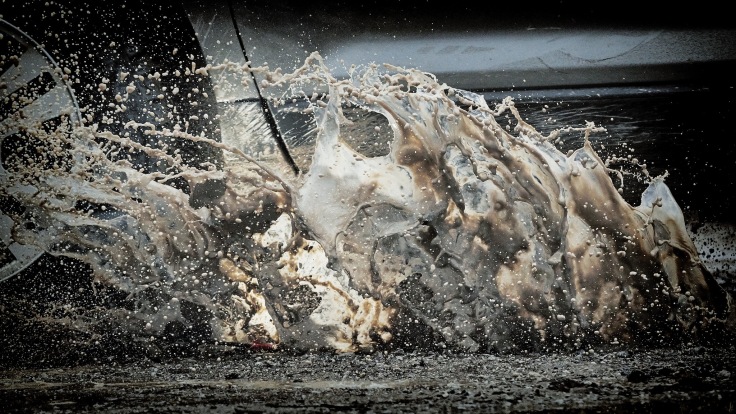
“Alhamdulillah,” I mumbled to myself as I looked down at my skirt and tights that were soaked through to the skin. “Ashukrlillah.” “Splash” by WS Squared Photography
The reaction surprised me. Not that long ago, a similar sequence of
events would have sent me spinning into feelings of self pity,
self-consciousness and whining at how unfair the universe was.
But something is shifting in me now. I
hear Dede’s voice in my head urging us, as an important first step to
spiritual transformation, to stop complaining and seeing the problems in
everything. Each moment contains a reason
to be grateful, he says. Gratitude to be alive, conscious, breathing.
Even when we’re irritated and dissatisfied, we can be thankful for
whatever the Divine Reality, Allah, has in store for us each day.
Huddled at the back, left-hand corner of a large hall, me and a handful of other women would gather to take part in the Islamic Friday prayer at our university in British Columbia the early 2000s. Meanwhile at the front of the room, where light streamed in from the windows, dozens of young men stood side-by-side in rows.
We recited the same prayer, but the gap in our experience was far wider than the swath of carpet separating the masculine and feminine in most Islamic religious spaces. As soon as we would say our final salams, I would dash for the door as quickly as I’d arrived.
Attending congregational prayers — where women are typically relegated to back corner, behind a partition or in a windowless room of a mosque — has always been an awkward and disheartening experience for me. The rigid segregation of religious spaces made me hyper aware of the limitations of my feminine identity, which I realized only years later were imposed on me rather than intrinsic to the tradition. That gnawing sense of discomfort made me ashamed of my girlhood, and eventually my womanhood in ways I can only now begin to articulate.
I was so immersed in patriarchy during my childhood that I assumed messages of faith could be communicated only through the masculine voice. After all, most references I encountered of God were as “He” and all the prophets in Abrahamic traditions were men.
Yet as I got older, my most intimate moments with Allah in personal sacred spaces had an entirely different quality. During early-morning prostrations before my Beloved, I had a deep sense that our connection was beyond constructions of gender and beyond my supposed inferiority. Rather, it was an exchange of energies that was deeply loving and nourishing. Something wasn’t right with the prevailing, masculine narrative of Islam, but I was unable to put my finger on why.
Image by Irina Naji
That changed when I became acquainted with the powerful women who have been largely erased from our spiritual histories. Their voices are muffled and faint not because they didn’t exist, but because they’ve been hidden and written out of relevance by patriarchal readings and writings of Islam.
The 2010 Hollywood celebrity fest chick-flick Valentine’s Day opens with Reed Bennett, a florist played by Ashton Kutscher, proposing marriage to Morley (Jessica Alba), as she wakes up on Feb. 14.
Evidently startled, Morley initially accepts, sending Reed on a joyful mission to let everyone know his sweetheart said “yes”! But his elation is short-lived. A few hours later Reed finds Morley in his apartment packing her bag as she hands back his ring and walks out on the relationship entirely.
Just then, as movie’s downtrodden protagonist leaves the scene, the narrator — a radio show host named “Romeo Midnight” — drops a word of wisdom that sounds a tinge sufi.
“It’s Romeo Midnight back again. And if those topsy-turvy feelings have got you twisted inside out, think of the poet Rumi who 800 years ago said: `All we really want is love’s confusing joy.’ Amen, brother.”
Heart of Steel, by Livlu Ghemaru
When I watched this movie shortly after its release, I was bemused at the irony of hearing a 13th-century Islamic poet and scholar quoted in a cheesy American blockbuster seemingly unwittingly. A Persian poet of love, Rumi is often uprooted from his historical context and polished for resale for Western audiences who may not realize his object of affection isn’t a romantic love interest, but the Divine Beloved.
In the heap of objects strewn across the dining room floor, I spotted
a sterling silver sugar bowl that was part of a four-piece tea set my
mom bought about three decades ago to entertain guests. I picked up the
bowl with one hand, while using the other to rummage through the pile of
papers, cloth napkins, tupperware and cutlery scattered beneath my
feet. I was curious whether the rest of the silverware was somewhere in
the mess left by the burglars.
When I couldn’t find it there, I
turned my head toward the tall oak buffet beside me, whose contents had
mostly been dispersed onto the carpet. Nestled in the corner of one
cabinet, the tea pot, tray and cream pitcher lay untouched.
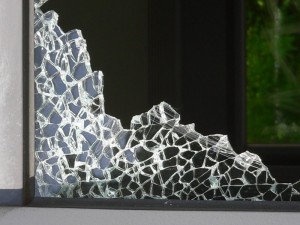
Shattered window, by Georg Slickers
The
sight of them startled me. A thick layer of black film had formed on
the surface of the silver, making it unrecognizable against the
shimmering exterior in my memory. It was no wonder the burglars who
ransacked our family home in Canada several weeks earlier had
disregarded the ensemble as they hauled away several electronics,
appliances and gadgets.
At that moment, a saying of the Prophet
Muhammad, peace and blessings be upon him, crossed my mind. “There’s a
polish for everything that takes away rust,” he said. “And the polish
for the heart is the remembrance of God.”
That was perhaps the
first time I’d considered this Hadith in a literal way. Acting on an
impulse, I grabbed an old bottle of silver polish from the mess on the
dining room floor and a soft sponge from under the kitchen sink, and
started to vigorously rub the tea pot. I was determined to make it shine
again like it did during my pre-teen years in Lethbridge and Calgary,
when my mom would fill it with her favored Red Rose tea to serve to
visitors alongside a slice of vanilla cake or syrup-drenched Egyptian basboosa.
Part
of me was grateful for a distraction from the pangs of sadness I felt
at seeing almost every corner of our four-bedroom family home turned
upside down. After learning of the break in, my sister and I made the
10-hour plane journey from London to Vancouver to assess the damage. We
found the contents and memorabilia contained in closets, cupboards and
drawers sprawled over our maroon-colored carpets.
Yet I wasn’t
mourning stolen possessions. The home I’d lived in as a student, and
visited almost every year since moving away after university, just felt
different. During those first few nights, each creak of the walls and
squeak of the furnace would cause a stir inside me. I envisioned we were
on the verge of another invasion of our privacy.
So as I hunched
over the counter top removing years of residue from the silverware, part
of me was nursing feelings of guilt for failing to safeguard our family
sanctuary. We’d made it easy for the robbers, who shattered the window
next to the front door and let themselves in when no one was in town.
There
was another motivation, though, for my spontaneous urge to shine the
silver. I was seeking reassurance that the polish would work when up
against years of neglect visible on the surface.
Turning on a tune by Egyptian legend Abdel Halim Hafez, my sister Mandy handed her iPod to Uncle Hoda and gestured him to place the headphones over his ears. Seconds later, an expression combining astonishment and glee came over his face while listening to a melody that must have taken him back at least three decades. Our uncle laughed and sang along to the words of “Gana El Hawa, the Love Came to Us,” while swaying his head from side to side, fully mesmerized in enjoyment of the moment.
If there’s anything that I will always treasure about my Uncle Hoda, who passed away last month following a battle with cancer, God bless his soul, it is that he was among only a small number of people that I’ve encountered who lived for the present.
I imagine it was Uncle Hoda’s deep connection with God that enabled him to embody this state of being. He spoke with great reverence of the Divine, and the love that sprang from that bond was contagious. Positivity and optimism radiated from him; whenever he entered a room, it was with the lightness and calmness of a person who was content with the joys and patient with the challenges of his life.
As my two sisters and I reminisced in our Whatsapp chat room about our beloved maternal uncle in the days following his passing, we alternated between tears and laughter. I was struck at how profoundly he had affected each of us, given we lived far apart most of our lives, Uncle Hoda in Egypt and us in a scattering of cities around North America, the Arabian Gulf and Europe.
It was joyous to reunite with our uncle during summer holidays, the distresses of our childhood dissolving away in his playful presence. He was consistently ready to offer a smile, which would make his small eyes almost disappear beneath his bushy eyebrows. Whether he was getting us to hum and sing along to the latest Egyptian pop song or sending us into an endless round of giggles during an afternoon drive around Cairo by swerving his car to the right and left in a zigzag pattern, Uncle Hoda always made us feel like the centre of his attention.
Sufi stories and poetry often allude to mirrors. Not the ones that immediately come to mind which we look at each day to see the outer image we project to the world. Rather, they refer to inner reflections that enable us to see our true nature. Sometimes this happens when we encounter a different perspective of ourselves revealed in another person’s heart and, through this, come to better understand the presence of God within us.
The image I saw glaring back at me that evening a few weeks ago was one I quickly turned away from on account of its unpleasantness.
Candle’s reflection, by Andreas Kusumahadi
Someone I cared for deeply, and who reciprocated this affection, spoke in anger and anguish of how they felt hurt by my actions. My instant reaction was to refute the criticisms outright to myself. I didn’t deserve these words, my injured ego protested. The comments delivered in fury simply could not be true since they were a far cry from the compassion, honesty and kindness I was striving to embody.
It’s at moments like this when I’m shaken by an interaction with a loved one, friend, colleague or even a stranger that I feel compelled to spend time in silent contemplation to reflect on the words that were exchanged and the events that unfolded. In his poetry, Rumi describes how it is through the wound that the light of truth enters us. “Don’t turn your head,” he says in his Masnavi, an epic Sufi poem conveying a message of Divine love and unity. “Keep looking at that bandaged place.”
He smiled at me, revealing a row of impeccable pearly white teeth. I’m not normally moved by a grin to stop in my tracks, but on this occasion a saying of the Prophet Muhammad, God grant him peace and blessings, flashed in my mind on how smiling at a fellow human being is an act of charity.
Since stumbling on this Hadith several years ago, I've become more receptive to how I share and respond to the simple gestures of kindness I encounter. In that moment, the young man’s vibrant smile and welcoming demeanour felt like a gift that I should acknowledge.
So I stopped, and we briefly exchanged niceties about how wonderful it was to be outside on an especially sunny August afternoon in London. He was a street fundraiser and I had willingly entered his open-air office, the door quickly closing behind me.
Photo by Andreea-Elena Dragomir
I imagined this gentleman, whose name I soon learned was Dale, spent much of that afternoon on the busy intersection in London's financial district, trying to attract the attention of the streams of well-paid professionals leaving their offices, in hopes a handful of us would agree to donate to a cause that would no doubt be a worthy one.
Each time I open the door to leave my apartment, I recite three poignant yet simple Islamic phrases in a subtle whisper that’s only audible to me.
“Bismillah,” Arabic for “In the name of God,” I say in a quick breath as I rotate the lock to the right and grasp the door knob. I continue with “Tawakkul ‘ala Allah, “I place my complete trust and reliance in God,” as I step into the hallway and gently close the door. And “Laa Hawla Wa Laa Quwwata Il-la Bil-laah,” or “There is neither might nor power except with Allah,” glides along my tongue as I turn the key fasten the lock until, by God’s will, I return.
It takes about seven seconds to recite these lines before dashing to the elevator to rush to work, run an errand, attend a social gathering or take a trip to a grocery store. The words are modest for the richness and tremendous power they encompass when reflected upon. They embody the essence of surrendering to God, which is what Islam is principally about.
Open door, photo by Brad Montgomery
In the basic definition, a Muslim is one who consciously lives in a state of presence with the Divine. When the prefix `mu’ is attached to a verb of four or more letters in Arabic grammar, it changes the meaning from the action to the doer of that action. For example, the Arabic word “to teach” is “darris,” and a teacher, the one performing the act of instruction, is the “mudarris.”
A Muslim, then, is one who performs “slim,” or “surrender.” When I discovered this simple grammatical rule six years ago while studying my mother tongue for the first time in an academic setting, it provoked an understanding inside of me. I realized that to truly be Muslim rather than simply label myself such, I needed to really experiencesurrender to the Divine, and that meant God should be the focal point of my consciousness.
At the time, I couldn’t have been further from this state of being. God rarely crossed my mind. While I believed the Divine existed, I would only turn to His/Her help when I was struggling to find a new job to escape clashes with a cantankerous boss I couldn’t see eye to eye with, or cope with a broken heart after a failed relationship, or pray for a loved one who had fallen ill or passed. Thoughts of the Almighty would flicker then quickly recede to the backburner of my mind once these desperations were resolved.
It dawned on me then that my faith lacked the depth and sincerity that comes when a human being is mindful enough to accept and be grateful for the blessings of life at all times, whether the circumstances are easy and difficult.
The Prophet Muhammad, peace and blessings be upon him, once described how“wonderful” a sincere believer’s circumstances are: If something good happens to her she expresses gratitude, and this is a blessing. When something negative occurs, she bears it with patience, and this too is a blessing.
Aspiring to draw nearer to this genuine form of Self Surrender, I started to infuse my daily routine with zikr – repeated acts of remembrance recited silently or aloud – until they became habitual.
In the name of God, the Infinitely Compassionate, the Infinitely Merciful We sent it (the Quran) down on the Night of Destiny And what will make you comprehend what the Night of Destiny is? The Night of Destiny is better than a thousand months On that night, the angels and the Spirit come down by the permission of their Lord with His decrees for all matters It is all peace till the break of dawn (Quran, The Night of Destiny, Surah 97)
During Ramadan, my perceptions of time somehow become more magnified.
At the onset of the Islamic holy month, the 30 days of fasting that lie ahead look lengthy and daunting, especially now as they coincide with the Summer Solstice and many Muslims in the Northern Hemisphere refrain from food and drink for 18 hours or longer. Yet even as we endure some of longest days of fasting of our lifetimes, Ramadan has once again hurried by and I find myself embarking on the sprint through the final 10 days. As the finish line comes into view, I can’t help but wish that it was further afield to give me more time to extract spiritual benefits from the month.
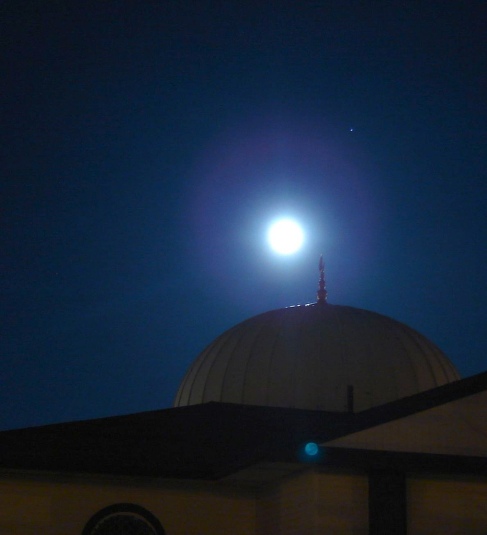
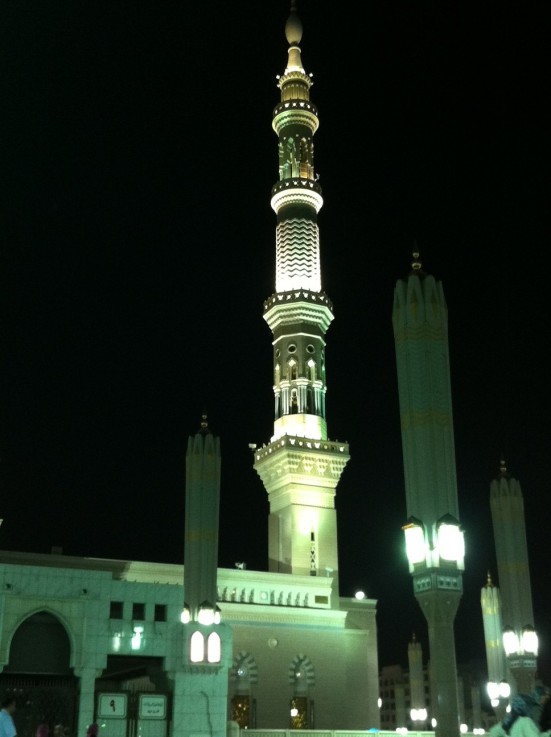
Mosque by moonlight, (Photo courtesy of Vicky TH)
With little room to scale back my working hours, I rely on evenings and weekends to dedicate more energy to prayer and reflection, Quranic readings, Sufi remembrance and meditation, and the giving of zakat, a redistribution of 2.5 percent of my wealth to the less fortunate. Carving out the hours needed for these acts of worship means I spend less time resting my head on my pillow and more on my prayer mat.
There is something pliable about the passage of time while fasting. Every second and minute tends to become more palpable when I’m craving a 10 a.m. caffeine fix to get me through then next wave of conference calls and news story pitches, only to look up at the clock and realize there’s another 11 hours and 24 minutes until Iftar, the meal to break the fast at sunset.
In this way, my perception of human time is heightened. Yet Ramadan also encourages me to perceive the expanse of eternity. One of the final nights of Ramadan is Laylat Al Qadr, or the Night of Destiny, described in the Quran as being “better than 1,000 months.”
While the 27th night of Ramadan is said to commemorate the historic night when Prophet Muhammad, peace and blessings be upon him, received his first Divine revelation in 610 AD, there’s also the belief that Laylat Al Qadr comes once in a year, most possibly during Ramadan, and most likely during the last ten nights of the month on one of the odd numbered nights.
It can be puzzling to think that a few hours in the tranquil evening stillness could hold such immense power as to encompass 1,000 months, the equivalent of 83.3 years. That’s more than the average human life expectancy in most countries. How could one night of spiritual reflection fathomably be greater than an entire lifetime?
Mosque by moonlight, (Photo courtesy of Vicky TH)
To begin to comprehend this idea, I turn to the Quran, where God appears to call on me to regard my perception of time as relative and flexible rather than linear and constant. For instance, the word for day in Arabic is youm, which I often think of as a 24-hour period. Butyoum in the Quran refers to eras or epochs of indefinite lengths, rather than a single day measured by the rotation of the earth on its axis. The earth, then, was created in six periods, not necessarily six 24-hour days.
“A Day with your Lord is like a thousand years of your reckoning,” the Holy Book says of how humans will conceive the length of a day when they reach the Hereafter. While our lives in this world may seem extensive to our intellect, when we return to our Creator, we will regard our time here as spanning merely “a day or part of a day.”
After first reading the Quran six years ago and realizing how transitory this journey of life truly is, my receptivity to God became amplified. I started to dwell less on the daily agitations that once consumed my thoughts, realizing how miniscule they were in the grander scheme of eternity. I’ve sought to be more conscious and attentive of my actions, prioritizing prayers, fasting and charity, while striving to treat those around me with kindness, respect and fairness.
For me, participating in Laylat al Qadr is about attaining a spiritual connection with the Divine that transcends well-ingrained notions of units of time. Many Muslims will spend the night in prayer and quiet reflection, some secluding themselves in mosques for the last 10 days hoping to seek the unparalleled benefit of a night when sincere worshippers are forgiven all sins and angels descend on earth.
In many ways, the first 20 days of Ramadan prepare me to be receptive to this possibility. Fasting forces me to confront my vulnerabilities and attachments to the ego. Pangs of hunger and thirst improve mindfulness; beyond the emptiness of my belly, I seek something within myself that isn’t starved in the same way, something that at other times of the year can get muffled behind consumption and external comforts.
“Fasting is meditation of the body, just as meditation is fasting of the mind,” writes Shaikh Kabir Helminski. “Hunger,” he says, “reduces the need for sleep and increases wakefulness. Eating our fill hardens the heart, while hunger opens the heart and increases detachment from material concerns. We become more free of needs, qualified by God’s name, the Self-Sustaining, Al Qayyum.”
While Prophet Muhammad continued to receive revelations for more than two decades after the momentous first Divine exhortation to “Read,” the beautiful messages contained in the Quran will always trace back to Laylat Al Qadr.
More than 1,400 years later we’re still invited to taste a hint of the sweetness of that momentous evening. For me, seeking to participate in it is a chance to traverse the world’s limitations to where time is incalculable and endless: where a moment of connection with the Divine Reality is so unfathomably rich that it surpasses lifetimes.
As I was growing up, Islam’s benevolent female saints existed in my imagination as otherworldly matchmakers.
Common features of my family’s infrequent summer holidays with relatives in Egypt were visits to mosques enclosing the shrines of Sayyida Zainab and Sayyida Nafisa, two descendants of the Prophet Muhammad who have come to be regarded as Cairo’s patron saints, may God grant them peace and blessings. My mother, often with her sisters who lived in smaller cities along the Suez Canal, would arrange mini pilgrimages to these grand Cairene mosques for a single purpose: to pray for suitable partners for their unmarried children.
Female worshippers gather around Sayyida Zainab’s mausoleum in Cairo
Amidst weeps and whispers, they would gather around the mausoleums of these saints offering earnest prayers to rescue their single daughters and sons from the matrimonial side lines. From beyond the divide between this world and the next, these venerable women of faith would intimately identify with the anguish of being the mother of an unwed child and act as intermediaries with God in removing the obstacles blocking the perfect partner from springing forth – at least that was the hope of my female kin.
While my own memories of these visits are vague and likely layered by personal accounts relayed by my mother over the years, the urgency placed on marriage left me feeling perplexed. The more I found myself becoming the focal point of the prayers, the more frustrating and painful these pilgrimages became.
By my mid- and then late 20s, the cultural pressures to wed young and my inability to make it happen inadvertently alienated me from faith, and obscured my view of the spiritual significance and prowess of these female saints. My only encounters with them were a manifestation of socio-culture pressures that dictate a woman’s value lies solely in her success as a wife and mother, a line of thinking that left me jaded and confined rather than empowered by their presence.
I was fully aware that within seconds my body would be drawn into a mass of humanity unlike any other in the world. “Surrender to the experience,” I thought while stepping into the overflowing main courtyard surrounding the Kaaba. The barriers that divide us in our daily lives are lifted here at the seat of the holiest site of Islam.
No honorary titles or entitlements have worth or function, there’s no distinguishing based on whether you are a woman or man, whether your income bracket is high or low. Rather, the bracketing qualities that contain us outside–our nationality, ethnicity, age, or skin tone–are shed at the door. Wherever our outward journeys have started, we all walk barefoot inward into a single circle, devoid of these unnecessary parenthesis appended to our identities.
“The goal of all is the same” no matter what road we took to get here or what quarrels we fought on the way, Rumi writes in Fihi Ma Fihi, It is What It is.
We are both universal and singular, each worshipper an equal soul before the Creator of all humankind and all being. Here we consciously move together in a unified mass, circling seven times around this stone cube as our prophets, peace and blessings be upon them, and our predecessors have for centuries. It’s become a timeless procession connecting us to the scattered cosmos. With the right kind of openness, the pilgrimage is a truly humbling, enchanting and purifying act of dedication to God, The Gracious One.
The ritual starts at the eastern corner, where the Black Stone is situated, a stone that Prophet Muhammad, peace and blessing be upon him, said was blackened by the sins of humankind after descending from heaven as white as milk. I’ve certainly swerved from the path since I was last graced by the opportunity to visit the Holy City five years ago. My soul yearns now for nourishment as I circle the four corners of the central cube draped in black.
I yield my body to the crowd that surrounds me in every direction, letting it move my limbs. I’m here for my soul, after all, and as we give thanks and make prayers to the Infinitely Compassionate One, drawing our attention to the Kaaba as birds circle above us, I concede any claim to the personal space that I normally protect.
Sometimes I find my body being drawn inward with an uncontrollable force, and it is suddenly so close to the edge of the Kaaba I can almost touch it.
My glossy burgundy subha had been dangling there for weeks, unused, upon the embroidered cushion resting casually against the Malaysian wood chair in my living room.
The prayer beads were almost camouflaged as they nestled into the tawny-coloured pillow cover I purchased during a trip to Istanbul six years ago, the image of a traditional Turkish tunic woven upon it in numerous shades of brown, gold, red and grey.
It was almost camouflaged. But mostly just overlooked.
I knew it was there, after all, for that is where I always placed the subha once I'd finished with it following a early-morning or late-night period of worship. Gliding each of the 33 beads slowly and methodically along the string with my index finger and thumb, I would repeat some poignant devotion between each click of a bead: one of the 99 Glorious Names of God, or a Quranic verse, or a phrase of sufi remembrance, all in an earnest effort to draw my attention to the Divine. Yet supplications, as important as they are in maintaining a consistent state of peace of mind and presence in Islam, are all too often left to fall by the wayside as I get swept up in my life. I find excuses for being too busy to do more than my daily prayers, and too distracted to remember that dhikr, a form of devotion involving repeated acts of remembrance recited in silence or out loud, is just as important to sustaining a well-rounded spiritual routine. For as many times as I may neglect them, though, those beads always lure me back, usually when a circumstance of life reminds me of my fragility.
For the past four years, every time I open the door to leave my apartment, I've
almost consistently recited three poignant yet simple Islamic phrases in a subtle
whisper that's only audible to me.
"Bismillah" (In the name of
God), I say in a quick breath as I rotate the lock to the right and grasp the
door nob. I continue with "Tawakkul ‘ala Allah"
(I place my complete trust and reliance in God), as I step into the hallway and
gently close the door. And "Laa Hawla Wa Laa
Quwwata Il-la Bil-laah" (There is neither
might nor power except with Allah) glides along my tongue as I turn the key
fasten the lock until, by God's will, I return.
It takes the whole of about seven seconds to recite these lines before dashing
to the elevator to rush to work, run an errand, attend a social gathering or
take a trip to a grocery store. The words are so simple for the richness and
tremendous power they encompass when reflected upon.
They embody the essence of surrendering to God, which is what Islam is all
about. When we say them, we are acknowledging that from the moment of
utterance, we're leaving it to the Gracious One to guide, protect and guard us.
And by doing so, whatever happens during the course of the day becomes a
reflection of that state of surrender, whether it is good or bad, easy or
challenging, unpleasant or comforting, agonizing or healing.
Everything becomes a blessing. While it is hard to imagine and accept
the heartbreak, illness, loneliness, professional struggles and relationship
setbacks that dot our paths as anything more than torment and nuisances, these
trials enclose gifts.
There's a stunning and thought-provoking Hadith, or saying of the Prophet
Muhammad, peace and blessings be upon him, where he describes how
"wonderful" a sincere believer's affairs are because, ultimately,
that person accepts with the certainty and the trust of all of her being that
the good and bad occurrences of her life are two sides of the same coin. I will
paraphrase and elaborate on this Hadith here.
For this person, this true believer, when something good happens to her, she bubbles
over with thankfulness. She doesn't lose sight of God's role in granting her
this gift. Rather, she acknowledges genuinely that He is the Source of it.
Perhaps the relief that she finds at her fingertips follows a period of immense
disappointment, the kind that drains your vitality and challenges your hope and
faith. Or maybe the joy comes to her during a period of relative peace and
harmony in her life, the very time when it becomes easy to dismiss remembrance of God.
In either scenario, the believer's response is to appreciate the gift with
humble gratitude to Her Creator. This is a blessing.
For the same person, when something burdensome befalls her, as will inevitably
happen, she bears it on her shoulders and perseveres. She carries the
heartbreak, loss, loneliness, illness, anguish with delight, embodying the
patience of "beautiful contentment" that the Quran refers to. That
patience isn't reluctant, but willing. It is full of pleasure because she
understands and exemplifies another message that radiates throughout the Holy
Book: that God will place no burden
on a soul greater than it can bear. The more daunting the burden He lays on her,
the stronger He regards her soul. So, rather than get filled with resentment,
this believer is glad. She smells the rose while grasping its thorny stem. She
knows with certainty in her heart that while the clouds may be blocking the sun
from view, its brilliant unmatched Light is there all the same. Her state of
patient being and acceptance is a blessing.
"Therefore do hold patience, a patience of beautiful contentment," Quran, Surah 70-5, The Ways of Ascent
In the moments before I first learned of the darkness unfolding in Paris on
Friday, I was sitting in a circle of light.
Some fellow seekers and I were seated as we often are on Friday evening, pondering on the path of those yearning for closeness and presence with
God.
On this particular occasion, we were discussing a passage of Islamic poet
Rumi's Masnavi called Veils of Light.
Each rich line reminded me of what drew me to this path of Islam in the first
place: a crystal clear moment of understanding in 2010 when I first encountered
that Light. When the first veil was lifted, revealing a love that transformed
how I would perceive everything from that moment.
We seekers will often squint, blocking the light from coming through, as we
endure the trials and tribulations that life hands to all of us. But there it
is, shining in once we gain the strength to open our eyes again.
This Light doesn't blind us despite its brightness, it transforms our vision
and allows us to see the next step on the path more clearly. This Light does
not bring darkness. It brings mercy, compassion and justice. This Light does not harm another soul, for harming one would be as damaging as
harming all, as the Quran teaches. It forces us, rather, to look within and
battle our own demon, the ego that prevents us from seeing the Light.
A wise, humble and loving Shaikh speaking on Islamic extremism to an audience gathered at a London church
in September described political Islam as "collective egoism: nafs (ego)
magnified on a social scale."
My late father never visited Paris. Yet for me he is always here.
Back in July 2010 during my first visit to this magnificent city, I
called my father while sitting in Tuileries, the beautifully manicured
gardens situated beside the Louvre.
What I didn't know then was that we were having our last proper conversation before my dad passed away,
suddenly, four weeks later. That bright and warm summer afternoon would be the final time he was alive
for me.
God has, miraculously, blessed me with the ability to
visit Paris numerous times since then. I have walked through Tuileries, pictured here yesterday, in every season. Whether summer, winter, spring or autumn, I sense my father's presence as I stroll across this elegant garden. Each time I have paused for a moment of reflection and remembrance. Al Fatihah, the opening verse of the Holy Quran, I have read for my father's soul.
While the details of our conversation are now a faint memory, the nearness that I sense to my father in this garden on which he never tread remains timelessly poignant.